Churchwomen Delegation
"The delegation experience challenges me to an even greater commitment to the advocacy education work I do. I'm greatly encouraged by the efforts of SHARE with women's empowerment and leadership for young women. This is absolutely necessary for peace in our world."
"I appreciated SHARE not spoon feeding data to us, but rather letting individuals learn from the conversations, the travel, and reflections shared."
"Once again my eyes and heart have been opened to the suffering that has been felt by the Salvadorans. Once again I am impressed with their hope and energy. I was very touched by the stark poverty of Llano Grande, but once again was moved by their hope."
Cretin Derham Hall
“I learned a lot in El Salvador and a lot about myself. I wish I could put it into words, but there are no words powerful enough to explain everything.”
"I learned that as a U.S. citizen, we have an impact on the countries of the world. It is our responsibility to educate ourselves so we can use our knowledge to help the world."
“Through this experience, I've been shown that the world has many issues and you can never be done learning about and questioning them. That is the only way to find solutions.”
I have learned more about the history and current political and economic structure existing in El Salvador. I learned more about the interconnection between El Salvador, the U.S., and other countries. I learned a simple way of life can be an effective and happy way of life. One of the most important lessons I learned is knowledge is power and one of the most important ways to help the poor and vulnerable. I also learned a lot about CAFTA"
St. Elizabeth Ann Seton Parish
“I learned so much: the history of El Salvador, the current issues that are affecting the country, more of the Spanish language, and what it really means to be a community.”
“I think the advocacy was well done – because otherwise the delegation would just be a “show and tell” without allowing groups to take back what they've learned and carry out their sistering relationship.”
“Learned of the challenge many people face in their everyday lives. The things we take for granted can not be afforded, like a high school education, clean water, food, medicine.”
“New perspective on faith and what it means to be a Catholic as described by Father Rutilio Grande and Mons. Romero.”

Showing posts with label Delegation. Show all posts
Showing posts with label Delegation. Show all posts
Thursday, April 14, 2011


Wednesday, December 15, 2010
Why the Four US Churchwomen are Important Today
On December 5th, St John Francis Regis, a long-time SHARE sister in Kansas City, MO, hosted a prayer service in commemoration of the four US churchwomen killed in El Salvador 30 years ago. Over 200 people attended a service that included processions, prayers and a powerful reflection by Sr. Mary McGlone. You can read the story about the event on a local newspaper's website.

 |
| Photo thanks to The Catholic Key Online. |
Father Tom Holder reflects on the date:
I believe there are several reasons why the commemoration is still important today. There is still work to be done and we need to remember the commitment and courage of the four churchwomen to give us strength to do the hard work of justice. We need to make sure the younger generation has a sense of the real history of the region and the ability our country has to influence things, both in good and bad ways. In the Kansas City area, there are growing numbers of Salvadoran immigrants. They are here because they still suffer hardship and persecution. We need to hear the stories so that we can continue to be in solidarity with the people of El Salvador. The four churchwomen teach us the importance of putting a face on the issues. They inspire us by their example and call us to see the people of El Salvador as our brothers and sisters.
Monday, December 6, 2010
Quotes from the final weekend of the Churchwomen Delegation
With the delegation coming to a close, delegates shared many interesting and profound responses to the experience with SHARE. We've compiled a few quotes here to provide food for thought to those of you who weren't able to join us in El Salvador for this memorable occasion.
The delegation spent the first part of Saturday in San Salvador
"The contrast between the ornateness of the main cathedral and the simplicity with which Romero lived his life was startling and very disturbing. It makes you question the role of the Catholic Church in the social issue of our times." -Belinda Monahan, OSB
"The contrast between the ornateness of the main cathedral and the simplicity with which Romero lived his life was startling and very disturbing. It makes you question the role of the Catholic Church in the social issue of our times." -Belinda Monahan, OSB
Thursday, December 2, 2010
Delegation Day 2: Ballet and La Pequena Comunidad
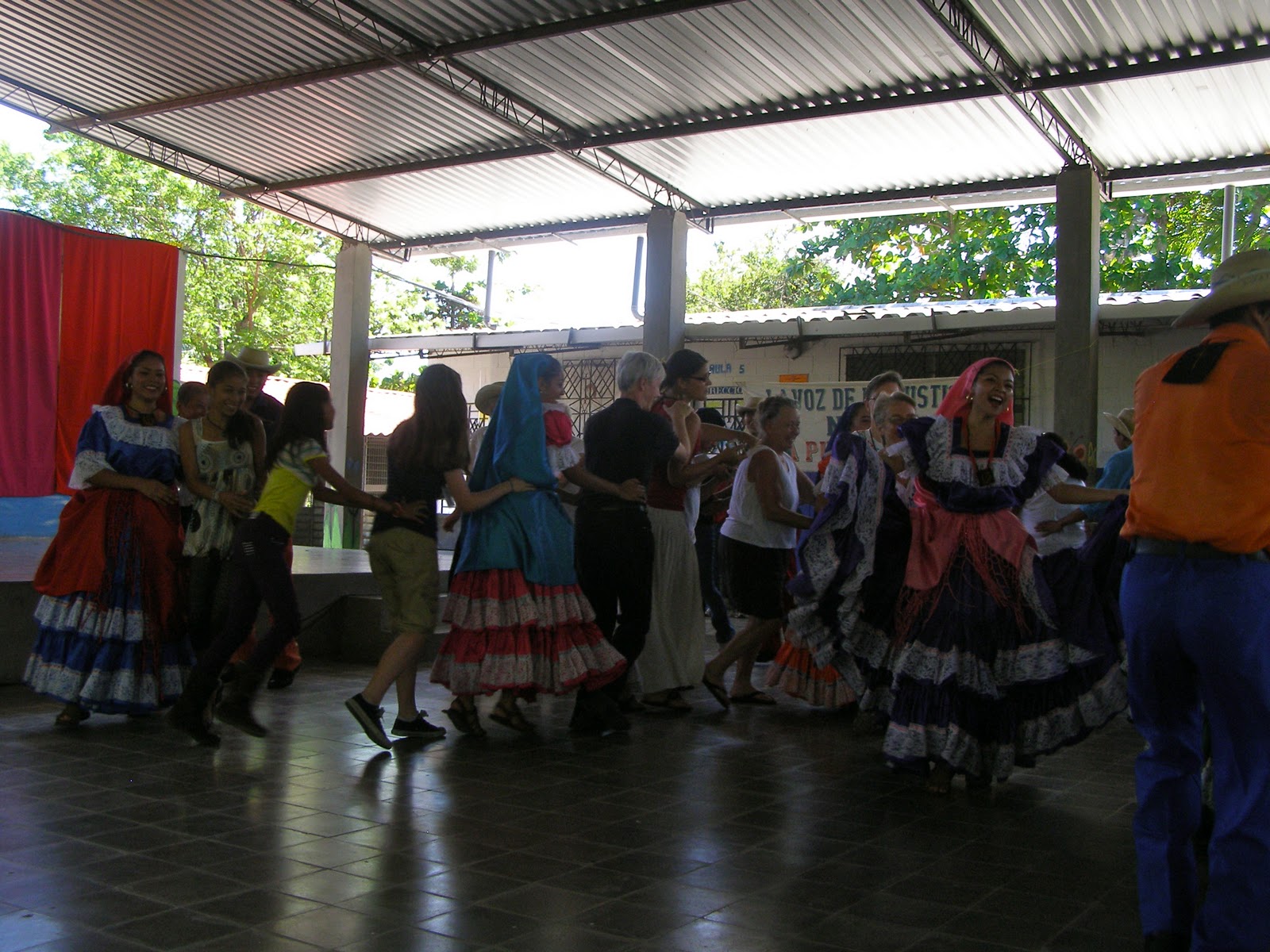 |
| Delegates joined the Folkloric Ballet in dance |
Watching a performance of the Folkloric Ballet was a highlight for the group. Shirley Tung from Pax Christi summed up the ballet performance like this: "I thought it was just a wonderful experience because I was able to share the spirit of the people that were dancing as well as all the people that were applauding for them. I have six left feet when it comes to dancing, but who cares. It was sharing in their happiness. "
Tuesday, July 7, 2009
Lessons of a Mango Tree
Below is an essay written by Cretin-Derham Hall High School teacher and SHARE delegate, Ellie Roscher. The essay was originally published in Alive Magazine.
 Lessons of a Mango Tree: Belief in New Life
The summer after my first year of teaching, I found myself sitting under a mango tree in the middle of El Salvador with a student named Sam. We sat on a bench together in a beautiful garden, looking at an intricate mural in an exotic country, yet the mood was somber and heavy.
Sam broke the silence we were sharing by whispering, “I do not understand, I cannot fathom how one person could ever kill a child.” I hoped he was not looking for his teacher to offer wisdom, because I had none. The world has the potential to be horrendously ugly.
In late July, 16 high school juniors, my two best co-worker friends and I left Minnesota to study the civil war in El Salvador. It was one of those trips that did enough filling to keep me full for quite some time. It was a journey that reinforced the idea that joy and sorrow come from the same well in our hearts. Our overscheduled lives of controlled routine were given up for guttural laughter and soul crushing tears within 10 minutes of each other. We sweated harder and experienced deeper joy and hurt in those 10 days than we had in the previous year of our formerly guarded, air-conditioned lives.
There is a part of the human spirit that knows that all humans have inherent worth and dignity. That part of the human spirit will always cry out for freedom, land, food, water, love and life. In the 1970s, a few families owned most of the land in El Salvador, and the people rose up out of their desperation. With the support of liberation theology and the Jesuit order, the guerillas went to war with the government in hopes of gaining more land, rights and power for the people....Continue reading "Lessons of a Mango Tree."
*Illustration by Meghan Hanson.
- Sara Skinner, US Grassroots Coordinator
 Lessons of a Mango Tree: Belief in New Life
The summer after my first year of teaching, I found myself sitting under a mango tree in the middle of El Salvador with a student named Sam. We sat on a bench together in a beautiful garden, looking at an intricate mural in an exotic country, yet the mood was somber and heavy.
Sam broke the silence we were sharing by whispering, “I do not understand, I cannot fathom how one person could ever kill a child.” I hoped he was not looking for his teacher to offer wisdom, because I had none. The world has the potential to be horrendously ugly.
In late July, 16 high school juniors, my two best co-worker friends and I left Minnesota to study the civil war in El Salvador. It was one of those trips that did enough filling to keep me full for quite some time. It was a journey that reinforced the idea that joy and sorrow come from the same well in our hearts. Our overscheduled lives of controlled routine were given up for guttural laughter and soul crushing tears within 10 minutes of each other. We sweated harder and experienced deeper joy and hurt in those 10 days than we had in the previous year of our formerly guarded, air-conditioned lives.
There is a part of the human spirit that knows that all humans have inherent worth and dignity. That part of the human spirit will always cry out for freedom, land, food, water, love and life. In the 1970s, a few families owned most of the land in El Salvador, and the people rose up out of their desperation. With the support of liberation theology and the Jesuit order, the guerillas went to war with the government in hopes of gaining more land, rights and power for the people....Continue reading "Lessons of a Mango Tree."
*Illustration by Meghan Hanson.
- Sara Skinner, US Grassroots Coordinator
Friday, April 17, 2009
Empowered Women, Empowered Communities!
Shoveling soil is HARD! That thought ran through my head over and over again as I watched SHARE Foundation’s delegates and members of cooperatives shovel compost as the sun beat down on the tin roof that barely covered the compost soil pile. We kicked up dirt and sand and soon everyone’s brightly colored sneakers were covered with muted brown earth. I gulped down water from my water bottle and wiped sweat from my brow with my sleeve.
The group I was with was comprised of
 Around 9AM, the SHARE delegates piled off the bus in the morning in La Bendición and were immediately greeted by a throng of excited, gregarious children. The delegates then convened with representatives from the Los Frailes in a community space, where individual farmers, both men and women, spoke about the benefits of using organic rather than chemical fertilizers and compost soil. Los Frailes participates in the Campesino a Campesino (Peasant to Peasant) Program, in which a local grassroots organization, CONFRAS, provides training on organic farming techniques and then encourages each participating cooperative to teach and train another community on what they learned. Farmers from Los Frailes spoke about the sense of empowerment they’ve gained by working together as a community in order to solve the community problem of hunger. To better illustrate their hard work to their visitors, the cooperative members took the group to a site where they were preparing compost soil. The cooperative members showed the different layers of the soil and invited the delegates to help “turn” the soil. Under the sweltering sun, the delegates took turns shoveling the compost, huffing and puffing with the effort. Rachel Ford, a freshman at American University and one of the first to volunteer to shovel the compost, stated, “I really enjoyed having the opportunity to work alongside the members of the cooperative and talk them about their experiences.” Luah Tomas, a freshman from
 We arrived in Zamorano in time for lunch with the Marta Gonzalez Cattlewomen’s Cooperative (ACAMG), who prepared a sumptuous feast for the delegates. After the meal, the women spoke to the delegates about their cooperative’s history, their challenges, and their hopes. ACAMG began as part of a larger, co-educational organization, but the female cooperative members did not feel supported or included in the decision-making processes, so they chose to branch off in 1993 to form their own women-run, women-only cooperative. The women told the group how they struggled with members of their community, mostly men, who told them that they were selfish for choosing to leave the larger organization. However, the women moved forward with their plans of creating a women’s cattle cooperative, and to date, around 300 women participate in the cooperative. The women smiled slyly when they said that now some men have asked to join their cooperative, but they have told them that the only way that can join is if they start wearing a dress. Because of their success, the women have expanded their cooperative’s mission and have begun literacy circles to encourage women to learn how to read and write. During our visit, a delegate asked the representatives of the cooperative if they preferred any particular candidate or political party in the upcoming presidential election. Most of the women agreed that they wanted the FMLN (Farabundo Marti Front for National Liberation) party to win, but they also reminded us that they had survived seventeen years without support from the government, and they would continue their work regardless of the election results on March 15, 2009. After the women’s presentation, Heather Wolfson, MAZON’s Marketing M
 At the end of our visit, the members of ACAMG invited the delegates to participate in a procession in memory of Rutilio Grande, a priest who was assassinated during
To learn more about SHARE’s local development programs, click here.
To support SHARE's projects, click here.
- Sara Skinner, US Grassroots Coordinator
Wednesday, April 8, 2009
SHARE delegate reflects on experience as an international observer
Jeannie Berwick, a SHARE delegate who monitored the presidential elections in March, reflects below on her experience as an international observer.
“Salvadorans, you have the sky for your hat, so great is your dignity.”
So begins the song that became the popular anthem of
 On March 15, 2009, seventeen years after the war, we witnessed the great dignity of ordinary Salvadorans as they voted in elections that were miraculously absent of the violence that has characterized the Salvadoran political process for generations.
We were in
We learned that before our arrival, the opposition candidate of the FMLN (Farabundo Martí National Liberation) Party had enjoyed a substantial lead for months before local media blasted the public with threats that employers would move their businesses abroad or shut them down if the FMLN candidate won. Even members of the US Congress got into the act. Republican Representatives Dana Rohrbacher and Dan Burton declared that if the Salvadoran people voted for the opposition candidate, (1) the Temporary Protected Status (TPS) program that allows thousands of Salvadorans permission to live and work in the US would be discontinued; and (2) El Salvador would be declared a “terrorist state,” which would prohibit Salvadorans living in the United States from sending money (“remittances”) to their families in El Salvador. To understand the implications of these threats, it’s important to note that remittances constitute a whopping 18% of
Our delegation responded by holding several press conferences to protest these threats and reassure the public that the Obama Administration had no intention of punishing the Salvadoran people for the free exercise of their vote. After international outcry, the US Embassy and State Department issued statements affirming the
 In presentations by various representatives from nongovernmental organizations (NGOs), the Salvadoran legislature, and the Supreme Electoral Tribunal (TSE), we learned that there is plenty of room for improvement in the current electoral system, including cleaning up voter registration rolls that include thousands of deceased Salvadorans, foreigners not eligible to vote under the Salvadoran Constitution, and people who have two voter registration cards (“DUI”). But our task on Election Day was only to observe the elections and note any violations of law; we were not in
To read the rest of the article, email Sara Skinner at skinner@share-elsalvador.org.
- Leslie O'Bray, SHARE Grassroots Education and Advocacy Intern
* Photos taken by Claudia Rodriguez-Alas
"El Salvador Elections: the Ghosts of Izalco"
Emily Achtenberg, a delegate from SHARE’s electoral observation mission, wrote this article about her experience on Election Day in Izalco, Sonsonate. Izalco is the site of the 1932 peasant uprising that became known as “La Matanza” (the slaughter). Due to great inequality between peasants and landowners and a fall in coffee prices, rebels rose up behind communist leader Augustín Farabunto Martí. The US backed dictator, Maximiliano Hernández Martínez, quelled the revolt in a few days, killing around 30,000 peasants.
March 15, 2009 - 4:45 AM
 As we approach the voting center in Izalco where our international observer team will be stationed, the weight of history is hard to escape. Both the left and right of El Salvador trace their political roots to this small town in the western coffee-growing department of Sonsonate.
Here in 1932, some 30,000 mostly indigenous peasants were slaughtered by the US-backed military dictator, General Maximiliano Hernández Martínez, following an unsuccessful rebellion sparked by the collapse of the coffee economy and the government's refusal to certify leftist victories in the local elections. Agustín Farabundo Marti, the Communist patriot after whom the FMLN takes its name, was captured here and executed for instigating the uprising--although recent scholarship emphasizes its indigenous roots and leadership.
Subsequently, all accounts of the insurrection and massacre ("La Matanza") were expunged from the public record. For self-protection, the region's remaining indigenous population (still one of El Salvador's largest) abandoned its native dress, language, and culture. Generations of Salvadoreños have grown up unaware of Izalco's history.
The right-wing governing ARENA party, along with its infamous death squads, was founded in Izalco in 1981. Every five years, ARENA launches its presidential campaign here, the place where the country was "saved from Communism." (The ARENA anthem extols El Salvador as "the tomb where the Reds will be buried."
ARENA controlled Izalco's local government for 28 years--until this past January, when the FMLN scored an upset victory in the mayoral election. Clearly the winds of change blowing across the country have reached Izalco, and the presidential election will be hotly contested here....
- Leslie O'Bray, SHARE Grassroots Education and Advocacy Intern
* Photos taken by Claudia Rodriguez-Alas
Wednesday, April 1, 2009
"Take off the 'Cold War’ glasses concerning Latin America"
 Below is an article written by Ollie Jefferson, one of 19 members of the National Lawyers Guild that participated as a delegate in SHARE's Election Observation Mission. The article, published in the Star Telegram, talks about her experience observing the Presidential Elections in March.
Joined by other members of the National Lawyers Guild, I was part of a delegation of international election observers who went to El Salvador to witness its March 15 presidential elections.
The delegation was sponsored by the SHARE Foundation, which has programs in El Salvador designed to meet basic human needs and build long-term solutions to poverty and social injustice.
Our participation, independent of the U.S. government, was an effort to see whether the elections were fair. While I have had hundreds of Salvadorans as clients and empathize with what they have suffered, my participation as a certified presidential electoral observer required objectivity.
At 5 a.m. election day, our group and the poll workers arrived to set up for what was a long-awaited event: the presidential elections in this Central American country. Their procedures are numerous and highly bureaucratic, developed over time to prevent fraud.
The first voter at my table was no more than 5 feet tall, minute, rather stooped over — an old woman coming to have her say...
To read the rest of Ollie Jefferson's article, click here.
- Leslie O'Bray, SHARE Grassroots Education and Advocacy Intern
Tuesday, March 31, 2009
Pictures of election observation in San Salvador
Claudia Rodriguez-Alas, SHARE's DC Policy Office Director, has uploaded pictures of SHARE's Election Observation Delegation. Most of her photos take place in different voting centers in San Salvador. To view the photos, click here.
- Sara Skinner, US Grassroots Coordinator
- Sara Skinner, US Grassroots Coordinator
"Election observer in El Salvador, a recession-proof spring break job"
Below is an article written by a Georgetown University student and SHARE Election Observation Delegate, Sarah Stodder, for her university's newspaper on her experience in El Salvador. Sarah is a member of the Georgetown Magis Group, a SHARE youth partnering group.
 Last Tuesday, I spent my morning in the noisy, sunlit streets of San Salvador and the night in Georgetown’s comparatively glacial climate. But the drop in temperature has actually been the easiest thing to get used to since my return. Not so easy have been my brief encounters with people I know, those friendly but slightly awkward and unfulfilling moments on the way to class when neither person has the time or desire to stop and talk. Each conversation follows a similar outline: “How was break?” One-word response. “Yours?” One-word response. Off to class.
I’ve been struggling to find a word for my break. Through Campus Ministry’s Magis Immersion and Justice Program, I spent ten days in El Salvador with nine other Georgetown students and three staff members. We visited impoverished and marginalized communities—places many Salvadorans themselves don’t see—where people showed us their living conditions and explained the situation in their country. We also served as International Election Observers for El Salvador’s March 15th presidential election.
Passing friends in a hurry, all the words I want to use—sobering, life-changing, uplifting—seem too heavy for a five-second conversation....
To read the rest of Sarah Stodder's article, click here.
To read another article on the Georgetown Magis Group's trip, click here.
- Sara Skinner, US Grassroots Coordinator
 Last Tuesday, I spent my morning in the noisy, sunlit streets of San Salvador and the night in Georgetown’s comparatively glacial climate. But the drop in temperature has actually been the easiest thing to get used to since my return. Not so easy have been my brief encounters with people I know, those friendly but slightly awkward and unfulfilling moments on the way to class when neither person has the time or desire to stop and talk. Each conversation follows a similar outline: “How was break?” One-word response. “Yours?” One-word response. Off to class.
I’ve been struggling to find a word for my break. Through Campus Ministry’s Magis Immersion and Justice Program, I spent ten days in El Salvador with nine other Georgetown students and three staff members. We visited impoverished and marginalized communities—places many Salvadorans themselves don’t see—where people showed us their living conditions and explained the situation in their country. We also served as International Election Observers for El Salvador’s March 15th presidential election.
Passing friends in a hurry, all the words I want to use—sobering, life-changing, uplifting—seem too heavy for a five-second conversation....
To read the rest of Sarah Stodder's article, click here.
To read another article on the Georgetown Magis Group's trip, click here.
- Sara Skinner, US Grassroots Coordinator
Tuesday, February 24, 2009
Press for SHARE's Election Observation Delegation
 The SHARE Foundation and its partners have been in the news of late! As Election Day in El Salvador nears, our grassroots partners are holding fundraisers to support SHARE's election observation delegation.
Over the weekend in Salem, OR, four college students showed documentaries that touch on human rights and social justice issues. The students were encouraged to take part of SHARE's delegation by Salvadoran Lutheran Bishop, Medardo E. Gómez, who visited Salem in October. Julie Silverman, a graduate student at Columbia University in New York, told the Statesman Journal that she sees this delegation as an "opportunity to make a difference in the lives of disenfranchised Salvadorans. Julia's sister, Bryn, plans to make a documentary of their experience. To read more about the event in Salem, click here.
On Saturday, February 21, in Washington, DC, a group of 16 American University students (see picture above) and their faculty advisor, Joe Eldridge, organized a concert and fundraiser for their delegation. The band, Nueva Cosecha, played traditional songs and pop songs, while guests munched on traditional Salvadoran cuisine. While the atmosphere was festive, the students were very serious about their participation in the upcoming delegation. José Henríquez, the co-student leader of the American University group, shared, "[The students] are learning the specific details of what it means to be part of an electoral observation mission, and the role that election observers play in a different country." To read more about the event in Washington, DC, click here.
For more Salvadoran election coverage visit the Coalition for Free and Fair Elections' blog.
- Sara Skinner, US Grassroots Coordinator
Friday, February 20, 2009
Unimaginable Pain and Exquisite Beauty
The following post is a testimony by Lisa Dennison, a parishioner at St. Patrick's Church in Seattle, WA, of her trip to El Salvador last summer through SHARE.
 Unimaginable Pain and Exquisite Beauty
"Sin abounds, but grace abounds even more." These words from Dean Brackley, SJ, of the UCA (University of Central America) perfectly describe my experience in El Salvador with our delegation this past June. It was a place of unimaginable pain and exquisite beauty.
I had been praying for an opportunity to leave my comfort zone - and our God answered my prayer abundantly. Intense heat, intense stories, and intense faith were things I experienced, and like all pilgrims, I could not remain unchanged by the reality that was set before me.
I will always remember the searing image of a tiny girl in a tattered dress standing blank faced and barefoot in a garbage dump while her parents foraged for something of value. I will recall with delight the lovely songs and prayerful reflections that were lovingly shared with us at the small but lovely church in Nueva Trinidad. I recall with deep sadness the tree in the center of the village which looked so beautiful, but held the history of unspeakable horrors that were committed in its branches. And my heart was filled with joy at seeing my daughters Sarah and Theresa find their place in the community of Nueva Trinidad, making it seem effortless to build relationship with smiles and a few spoken words.
Mostly I prayed for the grace to hold the difficult truths of this journey - the fact that over 70,000 civilians died in a civil war that our government was immediately involved with. The fact that while I saw Archbishop Romero's visage and words on murals in every small town we went through, and in every home that we visited, there was not one single picture or reference to him in the cathedral in San Salvador. The fact that the one water test we did in a nearby town concluded that bacteria was present, and a likely culprit of the many illnesses affecting local residents. The fact that urban parishes still lose parishioners frequently to violence as they try to minister to the youth who are attracted to gangs.
Yet the generosity of all those we met, their eagerness to share their stories, songs, and jokes with us seemed like shining stars in the black night of poverty and violence. Everyone I spoke to expressed deep gratitude for our visit - like we had given them something precious. Yet, as is so often true, I felt the richer for living with our sisters and brothers in Nueva Trinidad, and receiving the gift of their presence and the gift of their steadfast faith in a gospel that calls for freedom from oppressors.
I once read a quote from an aboriginal woman, "If you have come to help me, you are wasting your time. But if you have come because your liberation is bound up with mine, then let us work together." This amazing trip to El Salvador has reminded me of my own need for liberation, by being in a relationship with those who suffer and struggle for freedom in so many ways. I pray for the strength and courage to remain a faithful companion to our community in Nueva Trinidad - and ask that our parish of St. Patrick's continue this sistering relationship. I also am so grateful to have had the opportunity to represent our parish to those in Nueva Trinidad.
- Lisa Dennison
Posted by Sara Skinner, US Grassroots Coordinator
 Unimaginable Pain and Exquisite Beauty
"Sin abounds, but grace abounds even more." These words from Dean Brackley, SJ, of the UCA (University of Central America) perfectly describe my experience in El Salvador with our delegation this past June. It was a place of unimaginable pain and exquisite beauty.
I had been praying for an opportunity to leave my comfort zone - and our God answered my prayer abundantly. Intense heat, intense stories, and intense faith were things I experienced, and like all pilgrims, I could not remain unchanged by the reality that was set before me.
I will always remember the searing image of a tiny girl in a tattered dress standing blank faced and barefoot in a garbage dump while her parents foraged for something of value. I will recall with delight the lovely songs and prayerful reflections that were lovingly shared with us at the small but lovely church in Nueva Trinidad. I recall with deep sadness the tree in the center of the village which looked so beautiful, but held the history of unspeakable horrors that were committed in its branches. And my heart was filled with joy at seeing my daughters Sarah and Theresa find their place in the community of Nueva Trinidad, making it seem effortless to build relationship with smiles and a few spoken words.
Mostly I prayed for the grace to hold the difficult truths of this journey - the fact that over 70,000 civilians died in a civil war that our government was immediately involved with. The fact that while I saw Archbishop Romero's visage and words on murals in every small town we went through, and in every home that we visited, there was not one single picture or reference to him in the cathedral in San Salvador. The fact that the one water test we did in a nearby town concluded that bacteria was present, and a likely culprit of the many illnesses affecting local residents. The fact that urban parishes still lose parishioners frequently to violence as they try to minister to the youth who are attracted to gangs.
Yet the generosity of all those we met, their eagerness to share their stories, songs, and jokes with us seemed like shining stars in the black night of poverty and violence. Everyone I spoke to expressed deep gratitude for our visit - like we had given them something precious. Yet, as is so often true, I felt the richer for living with our sisters and brothers in Nueva Trinidad, and receiving the gift of their presence and the gift of their steadfast faith in a gospel that calls for freedom from oppressors.
I once read a quote from an aboriginal woman, "If you have come to help me, you are wasting your time. But if you have come because your liberation is bound up with mine, then let us work together." This amazing trip to El Salvador has reminded me of my own need for liberation, by being in a relationship with those who suffer and struggle for freedom in so many ways. I pray for the strength and courage to remain a faithful companion to our community in Nueva Trinidad - and ask that our parish of St. Patrick's continue this sistering relationship. I also am so grateful to have had the opportunity to represent our parish to those in Nueva Trinidad.
- Lisa Dennison
Posted by Sara Skinner, US Grassroots Coordinator
Monday, September 8, 2008
Josh from Shawnee, KS on Learning in El Salvador
 As many Good Shepherd parishioners know, our parish has had a sistering relationship with a Salvadoran community, El Buen Pastor for over 20 years. Through this we send support, both financial and spiritual, to the people of the community as well as delegations of local parishioners to El Salvador to experience what it is like living in a small, impoverished, rural community in the Salvadoran countryside and grow in brotherhood with a community so far away. Just recently I was one of the delegates who traveled to El Salvador and got to experience the country — everything from the heart-warming welcome of the Salvadoran people, to the grim reality of the mass poverty and violence that plagues the country. Looking back on this, I realize that this experience has changed my life, and the only thing left for me to do is speak to those who have not gone to El Salvador about the experience I had with our brothers and sisters in El Buen Pastor.
 Our delegation spent three and a half days in the capital of El Salvador, San Salvador. This is the largest city in El Salvador and where we saw some of the true beauty of the country, as well as some of the devastating national problems that the people in El Salvador face on a daily basis. One of the things that stuck out the most is the different types of housing all over the country, from brick one-story houses to small tin and aluminum shacks that litter the green countryside. Seeing such warm, compassionate and strong people living without common luxuries that I take for granted such as running water or looking out the window of the bus and seeing hundreds upon hundreds of small shacks built out of aluminum and other trash really got me thinking about what it would be like to live in El Salvador and not have so many of the things that I have. It was very touching just to look outside at a dilapidated, poorly built house and know that an entire family lives there. It made me want to bring justice to these people who have no hope of rising up in the world without the help of others.
Another very important part of our trip to El Salvador was going to El Buen Pastor and living with the people who are so close to many people of Good Shepherd parish. Some of the community members had previously been to Good Shepherd and all of the members were very welcoming and always gave all they could to make sure we were comfortable as guests. Seeing such great, amiable people working together with so little materialistically but so much spiritually really touched me in a deep way. It showed me that you don’t have to have a lot of fancy things to be happy. These people are a true testament to working for brotherhood and solidarity with each other. Their community was one of the tightest knit communities I have ever experienced. They take care of each others’ kids and help each other with work in the community. It made me wonder why communities and neighborhoods in the United States aren’t as close-knit and caring as El Buen Pastor.
Overall, what I’ve learned from my trip to El Salvador is that the Salvadoran people still need our help, and they have so much to teach us about hospitality and brotherhood. Going to a different culture and seeing how these people live has really showed me how much we, as cultures, need each other. We all must learn from each other and help out as much as we can. We owe it to the people of El Salvador as well as ourselves. We cannot forget about those who live far away because they need our help and have so much more to show us.
Subscribe to:
Posts (Atom)